Don’t Choose Between Economics and Financial Literacy

By John Brock
FTE Instructor
Teaching Professor & Director, Center of Economic Education
University of Colorado, Colorado Springs
Across the country, states are adding a required personal finance course and dropping the economics requirement, and students are the ones who lose by that trade. According to the Council for Economic Education’s 2026 Survey of the States, 39 states now require personal finance for graduation, but only 22 require economics, a net drop from 2024, driven by Texas, California, and Indiana replacing stand-alone economics courses with personal finance requirements. (Next Gen Personal Finance counts 30 states with a standalone personal finance requirement, since CEE’s 39 includes states that embed personal finance in another course.) The result is a generation that may learn how to read a pay stub, but not why wages, prices, and interest rates move as they do.
The impulse behind the mandates is sound. Parents and voters see credit card debt, student loans, and slim retirement savings, and they want schools to do something concrete. Personal finance is easy to defend because its payoff is immediate and visible: budgeting, compound interest, credit scores, insurance. Economics, by contrast, has a reputation as abstract, graph-heavy, and distant from daily life. In a crowded high school curriculum, the practical course tends to win.
Yet the two subjects are not substitutes. Financial literacy focuses on what to do. Economics emphasizes why things happen. A student who memorizes that diversification reduces risk, or that high-interest debt should be paid down first, has acquired a rule. A student who understands opportunity cost can see why those rules are held and can adapt when circumstances change. Rules expire, while reasoning does not.
Consider what a financially literate but economically illiterate adult looks like. He knows to start saving early, but he may not grasp why a “guaranteed” return of 20% should arouse suspicion rather than excitement. He knows that inflation exists, but not why central banks respond to it, or why his bond fund fell when interest rates rose. He votes on tax and trade policy without a framework for weighing trade-offs. Personal decisions and civic decisions both rest on the same foundation of economic reasoning.
So, what can be done? The most realistic answer, given how hard it is to add yet another required course to a crowded high school curriculum, may be to build a serious economics core into the personal finance course. This is not a matter of sprinkling in a vocabulary list. It means making economic reasoning the organizing framework of the course, so that budgeting, borrowing, saving, and investing are each taught as applications of key economic concepts.
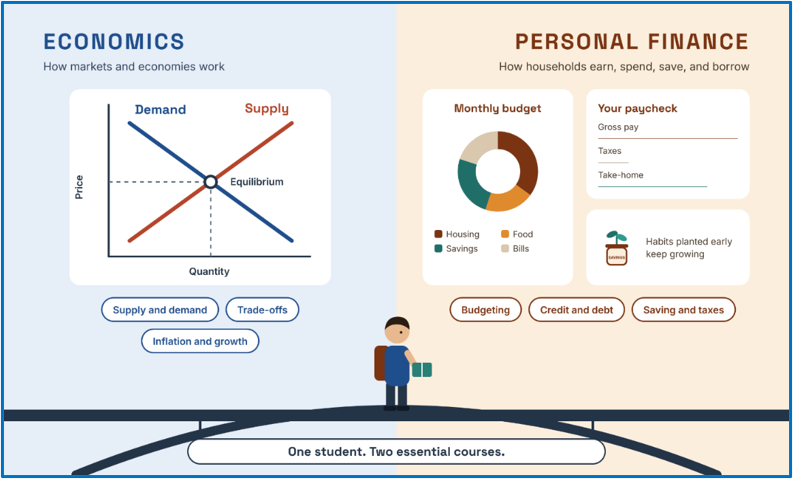
Start with the economic way of thinking: Scarcity, choice, opportunity cost, and incentives are the grammar of every financial decision. A budget is a scarcity problem. Choosing between paying down a loan and investing is an opportunity-cost problem. Why a car dealer offers 0% financing, or why a credit card advertises rewards, is an incentives problem. Teaching these economic concepts first makes everything that follows more coherent and easier to remember.
Next, explain why markets work. Students should understand how supply and demand determine prices, how prices carry information and coordinate millions of decisions, and why competitive markets tend to allocate resources efficiently. They should also see where markets fall short, which is the honest part of the story. Add the basics of economic growth, including productivity, investment, and innovation, and students will understand where long-run returns on stocks come from rather than treating them as a mystery.
Finally, give future investors the macroeconomic tools they need. Students may not require a full macro course, but they do need to know how inflation erodes purchasing power, how interest rates and bond prices move in opposite directions, what drives business cycles, and why recessions and expansions are normal features of an economy. An investor who grasps these ideas will be less likely to panic in a downturn or chase a bubble. Anyone who has watched people abandon sound plans during a market downturn knows how valuable this knowledge is.
None of this works, however, unless the teacher in the room understands both fields. A teacher who cannot explain why compound interest rewards early saving, or why diversification lowers risk without necessarily lowering expected return, will fall back on memorized rules. That is a real problem, because the people assigned to teach personal finance often come from math, social studies (history, government, geography), or career and technical education backgrounds, with little formal training in economics or finance. Strong teacher knowledge of both economics and personal finance is the foundation on which everything else rests. Economist Eric Hanushek, a leading expert on the economics of education, has studied this question. In his paper “The Impact of Teacher Subject Knowledge on Student Achievement,” he concludes that a teacher’s knowledge of a subject has a statistically significant positive effect on student performance in that subject.
This is why, after the financial crisis of 2008–09, I designed and taught a one-week professional development course for high school teachers through my Center for Economic Education at UCCS. The course, “Methods for Teaching Personal Financial Literacy with Economic Reasoning,” focuses on the economic logic behind personal finance decisions. An experienced high school teacher and I provide both the economic and personal finance content along with the classroom activities and methods for teaching it. Teachers leave with deeper content knowledge and with practical ways to help students connect each personal finance decision to the economic reasoning behind it.
This approach has costs. Textbooks and standards would need revision, and a one-semester course will have to make hard choices about what to cut. State standards could help by explicitly requiring the economic concepts inside the personal finance framework, rather than leaving them to chance. States should also invest in teacher training, because a well-designed curriculum is only as good as the person delivering it. Where possible, states should keep a stand-alone economics requirement as well, and the integrated course should be treated as a floor, not a ceiling.
Neither field is optional. Households that can budget but cannot reason about trade-offs, or that understand markets but cannot manage debt, are only half prepared. If legislatures insist on a single course, let it be one that teaches students both to manage their money and to understand the economy that money lives in, taught by teachers who understand both.
John Buck is also a valued member of the Foundation for Teaching Economics (FTE) faculty, where he contributes his experience and expertise to advancing economic education. Through his work with FTE, John helps support bringing economics education to teachers and students across the country.

Teacher Spotlight: Making Economics Memorable For Her Students
Students and teachers came together to explore economics, practice leadership, and learn from one another
Dick Cheney said deficits don’t matter. Tell that to your 7% mortgage.
Students and teachers came together to explore economics, practice leadership, and learn from one another